
Find Who Owns a Boone County Property
Start from an address or a parcel number. End at the newest recorded conveyance. The Assessment Detail card shows the exact roll label "Owner(s)," along with a legal description and often a Book/Page reference. Those fields lead to the County Clerk's deed record. A deed naming an entity or a fiduciary deserves a look at the organization or probate file, then a return to the deed to confirm what interest was actually transferred.
The name alone is not the answer. Ownership is best proved by matching the name, the parcel, and the deed description. Treat no single search result as final. A public roll can lag a sale because assessment data updates once a year. After a recent purchase, the newest recorded deed may show a different grantee than the card. Save the dates and the PID from both records.
- Use the address or parcel number to open the Boone assessment card and note Owner(s), PID, tax year, and legal description.
- Search the Boone County Clerk deed index for the card’s Book/Page or the owner as grantee.
- Read the latest recorded deed and compare its grantee and legal description with the assessment card.
- If the name is an LLC, estate, or trust, check the relevant state business or probate record for context.
Where Boone County Ownership Appears
Boone County ownership shows up in pieces across several offices. The Assessor's card names Owner(s) for a tax parcel. The County Clerk records the conveyance and its legal description. A Sheriff account ties that parcel to its tax ticket. The WV Property Viewer adds a Property Owner panel for any selected surface parcel. It also links straight to the assessment report. No single portal combines the full chain, payment history, and boundary evidence. There is no one official answer in one place.
| Source | Owner Info It Gives | Access |
|---|---|---|
| Boone Assessor card | Owner(s), addresses, PID, legal description, Book/Page | State assessment search and local office |
| Boone County Clerk | Grantor, grantee, recorded deed, lien, or release | IDX link or courthouse request |
| WV Property Viewer | Property Owner and selected parcel detail | Public map and assessment link |
| WV SOS / probate file | Entity or fiduciary identity context | Use when the recorded name requires it |
An owner-of-record name proves nothing about occupancy. The deed holder may not live there. Mailing Address is a tax-contact clue. It can differ from the site, and a Boone County deed may vest title in a trustee, an estate, a business, or a public body rather than an individual. Rely on the legal description and grantee language to place the right name with the right parcel.
Boone County’s Owner(s) Field
The Assessment Detail report carries the exact label "Owner(s)," placed beside the tax year, date, County, District, Map, Parcel No., Parcel Suffix, and the mailing and physical addresses. An E-911 address sometimes appears as well. It is the Assessor's owner display for that annual record. For a first answer to who owns a Boone County property, the field works well. It does not replace the recorded deed. Nor can it prove a recent sale has reached the next public roll.
A sample card adds a map view link, Tax Class, Property Class, legal description, deeded and calculated acreage, appraisal components, and building details. These cross-checks separate two people who share a name. They also tell a public parcel from a residence. Keep the full card, not just the name. Note its tax year and retrieval date.
Open the Boone County Madison owner card to see its exact field labels. Every card helps identify a parcel account. But the deed index must confirm the latest transfer before a name counts as the present owner.
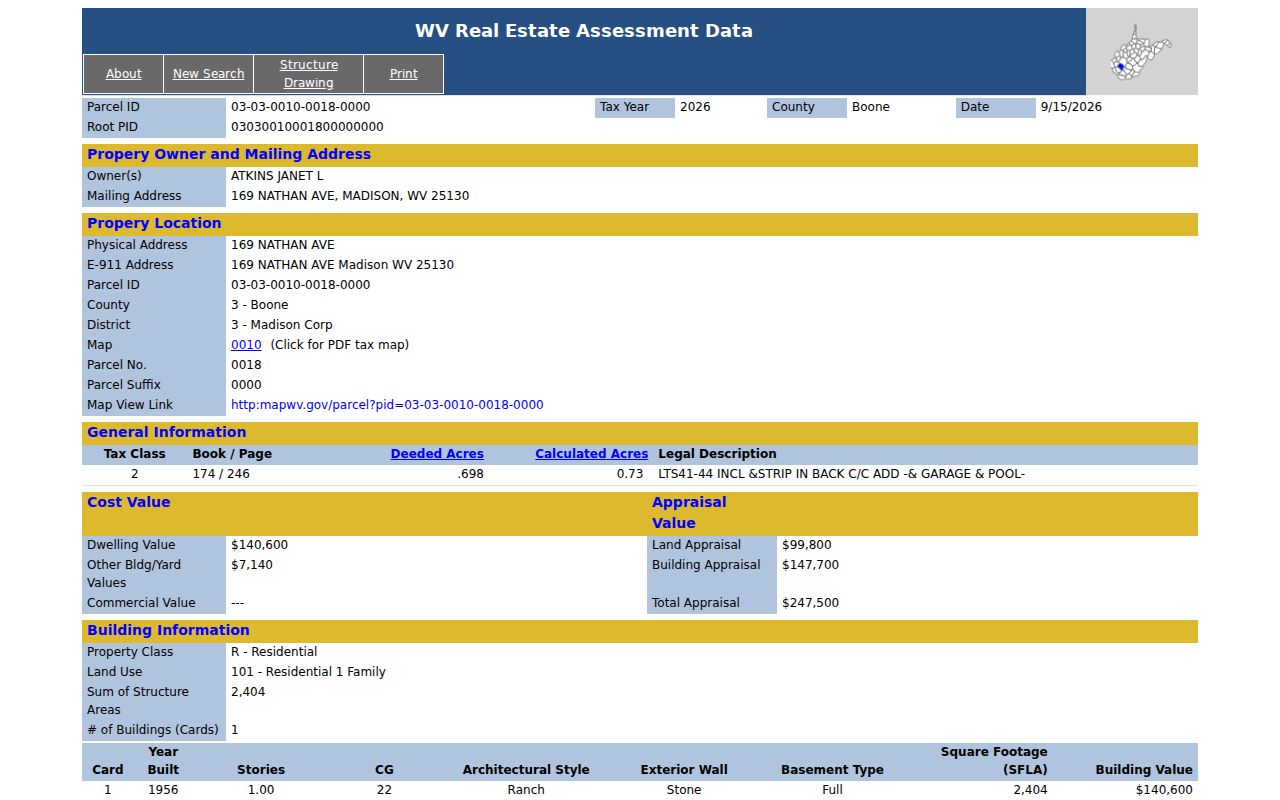
The card helps identify a parcel account. Confirm the latest transfer through the deed index before treating its name as the present owner.
Boone County’s Three Address Fields
The three address fields do different jobs. Physical Address, or situs text, locates the structure. An E-911 Address is the emergency address filed with the Statewide Addressing and Mapping System. Mailing Address simply routes tax notices, and it may be a post office box, a business, a public office, or another residence. Never infer occupancy from it.
Names and addresses often refuse to line up. Before deciding a card belongs to another parcel, compare the PID, the legal description, and the tax district. A wrong E-911 line belongs with the local addressing office, per the state. Never adjust a deed search on a postal city alone. Boone County spans rural and corporate districts. Its Community label on the map need not match the tax district or the mailing city.
Boone County Deeds Confirm the Roll
The newest recorded deed confirms the assessment lookup. Use the card's Book/Page to pull the deed. Or search the current Owner(s) as grantee in the County Clerk's IDX index. The deed image should show the grantor, grantee, recording date, instrument reference, and legal description. A shared surname is not enough. The tract must match too. An index row may lack an image. In that case, request the book and page from the Clerk or visit the courthouse.
The online-records page links to the Boone County document system. The Archives finding aid lists older index and book runs. Keep any release, deed of trust, probate order, or later conveyance that changes the chain. Need a deeper look? The Boone County current owner record route explains how to compare the assessment card with the newest recorded deed. That comparison catches errors early.
LLCs and Estates in Boone County Records
A Boone County deed or assessment card sometimes names an LLC, corporation, trustee, estate, fiduciary, or public agency. That name appears instead of a person. Start with the exact legal name. Then try a distinctive fragment or a punctuation variant if the first pass misses. The West Virginia Secretary of State Business Organization Search offers Organization and Agent/Officer/Name fields. It also includes a percent-sign wildcard tip. It can surface a registered agent or the legal entity name. But the agent is not automatically the owner. Treat that result as a lead, not an answer.
For an estate transfer, search the decedent, the estate name, the fiduciary, the heirs, and the purchaser. Search across both probate and land records. A will or appointment explains who holds authority. The fiduciary deed or court order is the actual evidence of the land transfer. Boone's Clerk handles probate and fiduciary appointments. Certified vital records remain subject to state eligibility rules. Use the state entity record as context. Then return to the Boone deed and parcel to confirm the recorded interest.
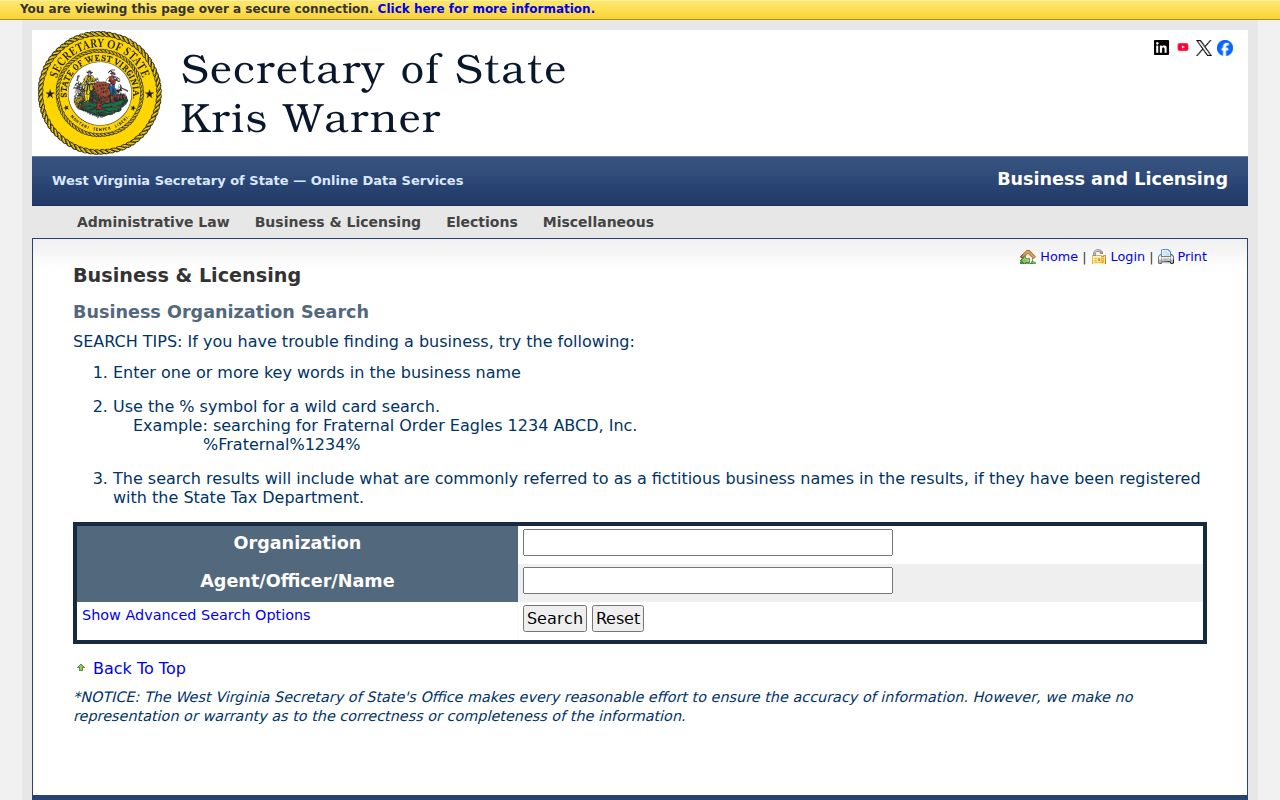
A state entity record is only context. Confirm the recorded interest in the Boone County deed and parcel.
Boone County Ownership Can Lag a Deed
Boone County's assessment roll follows a July 1 valuation and ownership date. The WV Property Viewer refreshes once a year when new assessment data comes out. A sale can be recorded after the assessment snapshot. That can leave the prior owner on the current roll. But the Clerk's deed index may already show the new grantee. So compare dates. Check the deed recording date against the tax year printed on the card. The roll and the index can disagree for a while.
Parcel geometry can lag too. When a parcel splits, the map line often updates later than the deed. State guidance sets certain map revisions for February 1 after the July-through-June transfer period. A boundary line can still be wrong after two years. The guidance advises contacting the assessor in that case. Ownership of a Boone County parcel may look unclear after a closing. Rely on the newest deed. Then ask the Assessor whether the roll has caught up. There is no fixed number of waiting days that applies to every transfer.
What a Boone County Owner Lookup Cannot Prove
Public property records can show a recorded owner of record. They also show the parcel details tied to it. They cannot prove occupancy. They do not guarantee title either. West Virginia property maps redact telephone numbers and security-alarm information. Vital, juvenile, sealed, and protected records follow separate access rules. An address match alone never establishes that the name on a public record is the person living at the site.
Lawful use. Use an owner lookup for property research, due diligence, or record verification. Do not use the information to stalk, harass, intimidate, or harm anyone.
A displayed owner or address can look wrong. The fix depends on which record is off. The Assessor maintains the annual assessment card. The County Clerk holds recorded deeds and can explain its index or an instrument copy. For records neither office will release, a West Virginia Freedom of Information Act request under W.Va. Code §29B-1-3 goes to the actual public-record custodian. That office generally must respond within five non-weekend, non-holiday days.
When asking about a single transfer, include the parcel ID. Include the tax year, deed date, and book/page too. Those details help the office tell a stale assessment field from a deed-index issue. They also keep the inquiry focused on the record rather than on occupancy. A public name cannot prove occupancy.
An owner search in Boone County sometimes returns several parcels at once. Compare the district, map, parcel, suffix, physical address, and legal description across the results. A shared mailing address is just a correspondence route, not a parcel identifier. Keeping those fields straight prevents mixing up parcels. It stops you from confusing a second lot, a nearby property, or a company account with the parcel you actually mean.