
The Values on a Boone County Property Record
A Boone County assessment card shows more than one figure. The tax roll carries an assessed value. The assessor also publishes an estimated market value for the same parcel. Beneath those totals sit the pieces: land, dwelling, and other buildings. Each has its own appraisal amount that adds to the whole. A deed in the property records may list a consideration figure from a sale. But that number reflects the terms of one transfer, not the assessor's valuation for the tax year.
| Value | What It Is | Where |
|---|---|---|
| Assessed value | The assessment amount used to calculate property taxes after applicable state rules. | Assessor card |
| Market / appraised value | The assessor’s estimate of full market value as of the assessment date. | Assessor card |
| Last sale reference | A recorded transfer and its stated consideration, if shown. | Clerk deed / assessment |
| Land and improvements | Separate land, dwelling, and other building components contributing to the total. | Assessor card |
West Virginia property is assessed at 60 percent of estimated market value as of July 1. That ratio explains why the assessed amount is normally below the full-value estimate; it is not a discount from a sale price. A deed amount may reflect a particular transaction, while the assessor applies its own valuation process to the parcel for the tax year.
The Boone County residential assessment card illustrates the land, dwelling, other-building, and total value fields.
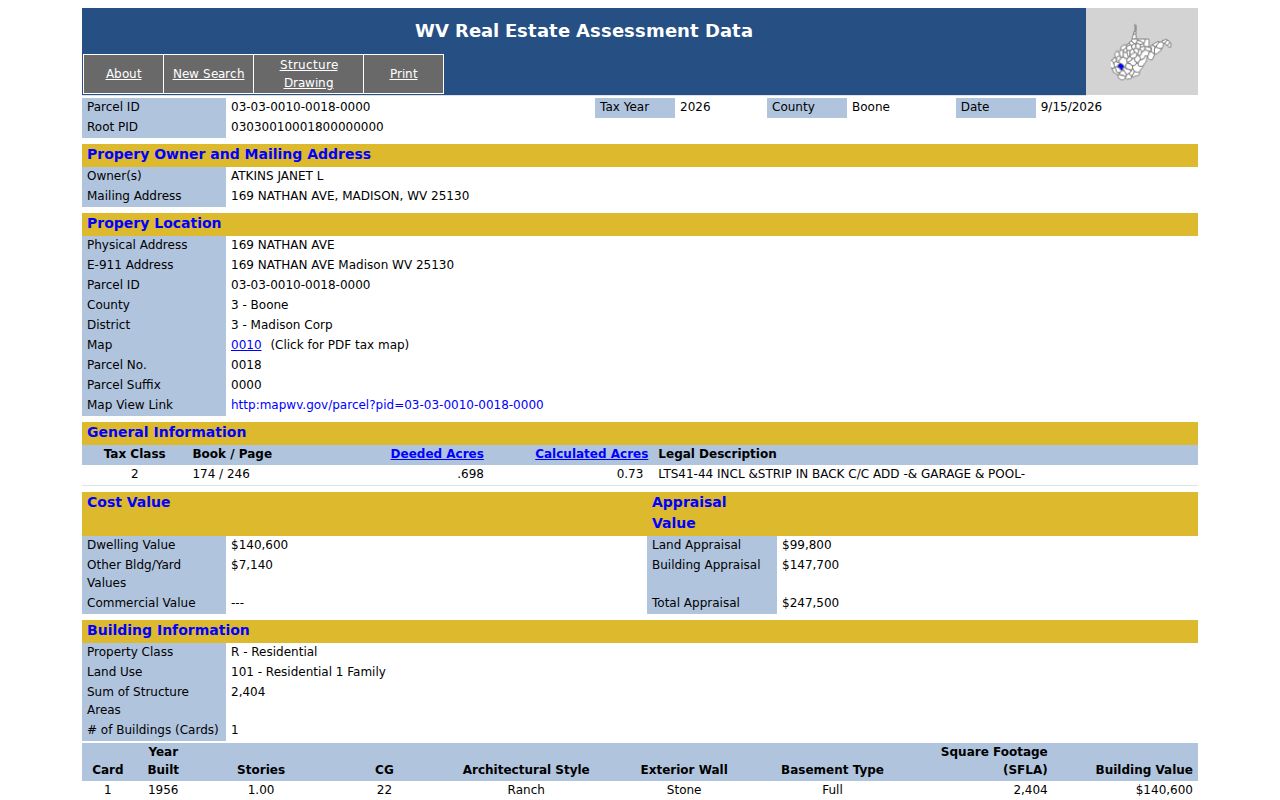
Note: Always read the tax year and assessment date on the card before comparing figures from different years.
Looking Up a Boone County Property Value
Begin at the WV Property Assessment search. Pull up the right Boone County parcel by street, owner, or parcel fields. The detail page lists the tax year, PID, deeded and calculated acres, and legal description. It also shows the valuation components. Match the parcel identifier carefully. A similar owner name or a nearby address can lead to a different account entirely.
- Search the address or district/map/parcel combination in the West Virginia assessment portal.
- Open the matching card and note the tax year, assessment date, owner, and parcel ID.
- Compare the assessed amount with the estimated market value and the land/building components.
- For a transaction reference, retrieve the deed and read its date, parties, legal description, and consideration field if one appears.
- Assessed value
- The amount carried into the tax calculation under West Virginia assessment rules.
- Market / appraised value
- The assessor’s full-value estimate for the parcel, distinct from an independent appraisal.
- Level of assessment
- The relationship between assessed value and estimated market value; West Virginia’s stated level is 60 percent.
What a Boone County Assessor Value Is Not
The assessor's figure exists to keep tax administration fair and consistent across thousands of Boone County parcels. It is not an inspection-based opinion prepared for a specific buyer, lender, or estate. Expect differences from a recent sale because of the valuation date, property condition, market movement, and mass-appraisal methods.
Value vs price. A Boone County assessment is a public tax value, not a promise of what a property will sell for. Use a qualified appraiser for a transaction-specific opinion.
Boone County Values Use a July Assessment Date
The Assessor values property as of July 1, and the state data refreshes on an annual cycle. Statements mailed July 15 are based on property owned the previous July 1. A new improvement or transfer after that snapshot may not appear as expected in the current online card. Compare like tax years rather than treating a current screen as a real-time valuation.
The Assessor’s published calendar also identifies informal review and Board of Review and Equalization timing. An owner disputing a valuation should follow that schedule and ask the office how to submit supporting evidence. The annual card is a public starting point; it does not replace the notice or explain every adjustment made to an individual parcel.
The Boone County Assessor’s calendar is the county source for the published assessment and review dates.

Note: Check the current notice and county calendar for the dates that apply to your tax year.
Separating Land and Building Values
The assessment card breaks out land, dwelling, and other-building amounts. Those components show how a total was assembled and whether the parcel includes an improvement. They are not independent appraisals of each feature. A missing building entry does not prove no structure exists. Read the property class, acreage, card date, and parcel identity together. Deeded acreage comes from recorded conveyance information, while calculated acreage may come from mapping. When the two differ, that discrepancy is a reason to inspect the deed or a survey, not a basis for multiplying the total by a guessed per-acre figure. The tax map serves assessment reference only. A boundary decision needs a survey and the controlling land description.
Comparing a Recorded Sale With a Tax Value
A sale in a deed index proves a transfer happened. But the amount needs context before it supports a price comparison. The date may fall after the July assessment date. The conveyance may involve related parties. The deed may not even state consideration in a usable way. Review the recorded instrument and any transfer details. Do not assume one transaction resets every assessment figure. For a meaningful comparison, note the parcel ID, tax year, sale date, deeded acreage, and property class. Note the land and building components too. Then look at similar parcels with attention to location and use. A county value can support a tax review or a public-record comparison. For a current market appraisal, a licensed professional is the right source. The Boone County deed records guide explains where transfer instruments are indexed. It also covers how to request a copy.
Reviewing a Boone County Property Value Notice
A number that looks wrong has an orderly fix. Confirm the parcel number and tax year before anything else. Then compare the assessment card against the notice, deed, acreage, property class, and the recorded legal description. Comparable sales help too. They must match the property's location, use, size, and condition as of the relevant valuation date. Submit the question to the Assessor inside the review window. Keep the written response. File it with the parcel record.
West Virginia treats the homestead credit and value appeals as two different procedures. A qualifying owner may carry a $20,000 homestead exemption, though eligibility rules and filing deadlines apply. The credit never alters the estimated market value field. Questions about taxes due, tax tickets, or payment status go elsewhere. Those belong on the Boone County property tax records page.
The county calendar sets the rhythm. A January 15 notice covers a qualifying increase. Informal assessment reviews run through the rest of January. Board of Review and Equalization hearings happen in February by appointment. Those dates apply to assessment review only, not to every notice or tax-payment deadline. Keep the notice, parcel PID, comparables, and any photos or repair records organized by assessment date. Ask the Assessor which materials it accepts that year.
Sometimes the dispute is arithmetic, not value. Compare the tax class, assessed amount, exemptions, district levy, and payment status on the ticket. A credit or a special tax status can shrink a bill without touching the parcel's estimated market value. When the record labels do not explain a difference, use the county contact route.
Boone County Homestead Credit and Property Value
A homestead exemption trims the taxable amount on a qualifying owner's bill. It does not lower the assessor's estimated market value or rewrite the property's sale price. In West Virginia the exemption can remove up to $20,000 of assessed value on an eligible home. It applies to owner-occupied residences. Requirements cover residence, age or disability, occupancy, tax-payment, and filing. December 1 is the filing deadline. An owner staying at the same residence generally does not refile each year.
Read the assessment notice and the tax ticket as separate documents. A valuation question goes to the Assessor and its review schedule. Did the exemption get credited? That question goes to the office handling the application or the bill. A denied homestead application carries a 30-day appeal window to the County Commission. So confirm the notice and deadline before filing.
Never compare a post-credit tax bill against the gross assessment on another parcel. Don't call the gap a market-value change. Work from the land, improvement, total appraisal, assessed value, tax year, and any exemption line. That reads each property's record correctly.